MENGA
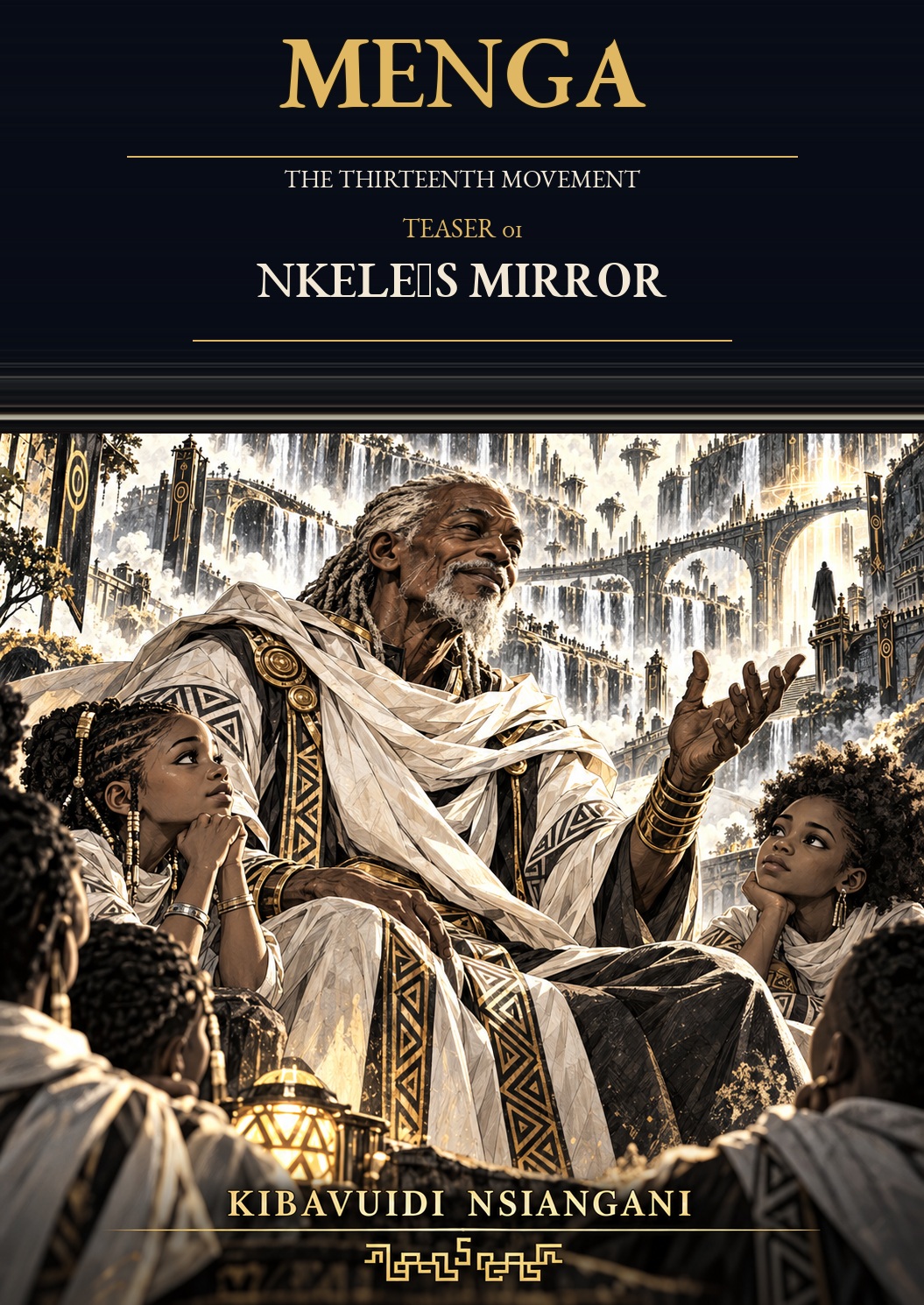
Nkele’s Mirror
Konzo had held lines while the land itself changed beneath his boots. He had survived K’s training, hostile crossings, and commanders who mistook caution for cowardice. Yet when Tuti asked why he had eaten half of Nzitani’s cake, he found himself wishing the ground would open and swallow him.
◆
By late afternoon, the mist from the upper falls had reached the market terraces.
It came down in thin, wandering veils between the high bridges, gathered on the leaves of the courtyard trees, and made the stone steps shine even where nobody had washed them. Below, New Kongo was finishing its day's work. Delivery carts trundled along the lower arcade. Someone in a workshop was testing a cutting machine whose every third pulse made the cups rattle on Nzitani's table. Above the waterfalls, the slender towers stood in the pale gold of the declining sun, connected by bridges so fine that a visitor might have mistaken them for lines drawn on the air. Two watch platforms stood above the eastern gardens, looking down over the transit routes and water catchments. A mango tree had grown through the old stone rail of the nearest gallery; no one had moved it. They had built a new handrail around the trunk.
Nzitani had spent most of the day in uniform. A regional command review had run into the afternoon; then two neighboring families had asked the House of Nzinga to intervene in a dispute over a retaining wall that carried part of their shared irrigation system. They brought documents, measurements and a considerable quantity of resentment. By the time Nzitani reached them, a workman repairing the channel had fallen against a broken fastening and torn an artery in his forearm.
She did not restore him with a gesture. She knelt in the wet earth beside the medical team, asked for the vascular image and watched the branching structure illuminate the physician's portable display. She understood this injury: precisely where the vessel had opened, which tissues had lost perfusion, what pressure the damaged wall could bear. The physician secured the wound. Nzitani helped guide the living process at its narrowest, keeping tissue viable while the repair took hold. When the man's hand warmed again, she withdrew before the surgeon had finished checking it.
"Don't bend it because it feels better," she told him.
"I wasn't going to."
She glanced at the tools lying beside him.
"You already did once."
He looked sheepishly at the physician, who gave a small, exhausted nod.
Nzitani was the Great Protector of Life, general of the House of Nzinga and its head. Those titles had not shortened the afternoon. She still had to listen to the neighbors explain why the same stone belonged to both of them. She appointed a joint inspection at first light, then walked home with the sharp ache that came when she had held herself composed for too many hours.
She arrived at the veranda without the armored breastplate of her field uniform. Under the loose cream overshirt her shoulders retained its memory. Her dense black afro had escaped its fastening and spread into a broad, magnificent silhouette above her narrow gold headband. She had a strong, expressive face, alert dark eyes and an impatient little line at one corner of her mouth that her friends recognized as the warning she was too tired to be diplomatic. Two delicate nicks marked the backs of her hands. She had not noticed them until she reached for the bench.
She set her bag beneath it, removed the band from her wrist, and stretched her aching fingers.
"You look as though the wall won," Konzo said.
He had arrived without announcing himself. Konzo wore his dark, tightly curled hair short enough to clear his collar; the small beard framing his face was less orderly after a day's work. His jacket lay over one shoulder, and a pale line of field dust ran down the side of his neck. His warmth showed first in his eyes, though the rest of him was made for difficult terrain and harder decisions. He set a paper bag beside her cup.
"The wall has excellent representatives," Nzitani said.
"Did anyone ask the wall what it wanted?"
"Tuti would have."
"Tuti would have charged it with refusing to cooperate."
Nzitani opened the bag. Inside were two warm cakes wrapped in leaves, their edges darkened by the oven. One had already been broken.
She looked up.
"You ate my cake."
"I checked that it was safe."
"Half of it?"
"The danger was difficult to assess."
She held his gaze until he smiled, then drew the second cake toward herself. Konzo sat down beside her with the unceremonious relief of a man who had been on his feet since morning.
Konzo had taken one bite when a voice behind him said, "So that's where her cake went."
He stopped chewing. Nzitani kept her eyes on her food, although the corners of her mouth had already begun to betray her.
"Good evening, Tuti," Konzo said.
"Good evening. Did you buy that for my sister?"
"Yes."
"And then eat it?"
"Part of it."
"Interesting courtship."
Tuti stood by the doorway, lean and restless, his shaved head catching the last clean light from the west. The light at his fingertips—he had been idly rolling a little strand of it between finger and thumb—went out when Nzitani looked up. He was still wearing the pale, patterned armor he preferred on working days, though the dust on one shoulder suggested he had found a reason to spend the morning somewhere less civilized than the courtyard.
"Leave my cake alone," Nzitani said.
"I'm trying to understand the man who keeps eating it."
Konzo swallowed. "You understand me very well."
"I used to."
"Tuti."
"We grew up together, didn't we? You, me, Wete. I knew you before any of us could go anywhere without an instructor shouting after us."
"You were the one they were shouting after."
"That's beside the point. Then we spent years training and travelling together. You could have told me."
"Told you what?"
"That you liked my little sister."
Nzitani raised one eyebrow. Konzo's expression changed with the particular discomfort of a man who had survived hazardous missions with Tuti and still could not find a safe route through this conversation.
"You know her," he said. "We've all known each other since we were children."
"I know her. That's what worries me. You knew her when she was small enough to steal your seat. And now you sit there pretending you only came for the cake."
"I did come for the cake," Konzo said, then heard himself. "No. That's not what I meant."
"I know exactly what you meant."
"No, you don't."
"Now you're arguing with the family."
Wete arrived with a low table beneath one arm and several cushions tucked under the other. Tall and heavily built, his shaved head and short beard made his quiet expression seem even more composed. He set everything down gently, without jarring the cups, and glanced once at Konzo's face.
"You started without me," he said.
"He started," Konzo answered.
"I can tell. You're sitting like somebody's examining you for a wound."
"I am," said Konzo.
Wete sat beside him, smiling. For years the three had fought, travelled and learned together. Tuti would trust Konzo with his life in an instant. That did not stop him from treating Konzo's feelings for his sister as a personal betrayal whose details demanded continued investigation. Wete, who understood both men, had become very good at recognizing when friendship needed defending and when it simply needed to be laughed at.
"It's a reasonable question," Tuti insisted. "I have friends. I have brothers. I don't have friends who are interested in becoming my sister's husband. At least not until one of them actually is. So what exactly are you in the meantime?"
Konzo rubbed a hand across his mouth. "Your friend."
"Suspicious answer."
"You asked."
"And you avoided the interesting part."
Nzitani set down her cup and rose. The evening breeze had loosened her afro around the gold band, and there was weariness in the way she rolled one shoulder after a day of command reviews and medical work. She crossed the few steps between herself and Tuti and wrapped both arms around him.
He went rigid immediately.
"What are you doing?"
"Thank you, mbuta."
"For what?"
"For taking such good care of your little sister."
"I'm not—" He stopped, conscious of Wete watching him. "That's what an older brother does."
"I know." She rested her cheek briefly against his shoulder. "I love you too."
"Nzitani."
She held him a moment longer, then stepped away with the perfectly innocent expression that made her a formidable negotiator even when she was genuinely fond of the person before her.
Tuti looked at her, then at Konzo.
"Wait. You're doing this so I'll leave him alone."
"Doing what?"
"Don't give me that face."
"I said thank you."
"And the hug?"
"You don't want your sister to hug you?"
"Of course I do. That's not the—" He struggled with the sentence. "It isn't working, you know. If anything, I'm angrier. She never used to be this cunning," he told Konzo. "Look what you've done."
"I taught her how to hug her brother?" Konzo asked.
"Don't help your case."
Wete laughed, and Tuti looked betrayed by the sound.
"Some friend you are."
"You said you weren't going to make him nervous tonight," Wete reminded him.
"I'm keeping him alert. There's a difference."
A voice from the corridor said, "About what?"
Konzo stopped smiling.
Kieleka had reached the veranda without the sound of his approach carrying ahead of him. He paused to let an elderly neighbor pass, then stood in the doorway, broad and almost motionless in dark field clothes. His hair was cut close; a strong beard defined a face that rarely gave away his judgment. There was nothing performative about the stillness. The Disu dia Yisu had taught Kieleka to study a situation before disturbing it; his restraint unsettled people more than his strength. Konzo knew this, but it was the ordinary silence that troubled him most.
"Nothing," Nzitani said.
"Family business," Tuti said at the same time.
Kieleka looked at the two of them, then at Konzo, who straightened without intending to.
For a few long seconds Kieleka said nothing. He didn't narrow his eyes, didn't fold his arms or offer a warning. His gaze rested on Konzo with the unreadable patience that had once made hardened opponents question decisions they had been certain of five minutes earlier.
"Are you all right?" Kieleka asked.
Konzo opened his mouth, discovered he had forgotten what he was going to say, and answered, "Yes."
Kieleka nodded. Then he took Nzitani's hand and examined the two small cuts near her knuckles.
"Wash those again."
"I already have."
He looked at her.
"I'll do it," she said.
That was all. Kieleka picked up a tray that had been left precariously near the doorway and carried it to the serving table.
Konzo breathed out.
"See?" he murmured to Wete.
"He came for a tray," Wete said.
"He looked at me."
"He looks at everybody."
"Not like that."
"Like what?" asked Diya.
Konzo's shoulders tightened again. Diya had appeared from the garden path carrying a compact instrument and a bundle of notes. Her long braids were drawn over one shoulder, the cuffs of her fitted robe edged in fine gold. She noticed his expression at once. A small smile followed—brief, unmistakable, and entirely too pleased with itself.
"Why are you sitting like that?" she asked. "Trying to look impressive?"
"No."
"Because it doesn't suit you. You're usually quite capable of speaking."
"I was speaking."
"Before I arrived, apparently." She put the instrument aside. "And if you freeze every time one of us walks into a room, how do you expect to protect my sister?"
Konzo answered before he could stop himself. "Protect her from you?"
Diya tilted her head. The smile had almost gone, except for the trace in her eyes.
"Are you arguing with me, young man?"
"No, ma'am."
Nzitani laughed outright. "Diya, that's enough."
"I only asked him a question."
"You enjoyed asking it."
"Of course."
Diya took the nearest chair and began sorting through her papers as though nothing unusual had happened. Konzo wiped the faint dampness from his palms against his trousers.
"You know she does that on purpose," Wete said quietly.
"I know."
"Mbuta K used to say you handled pressure well."
"Mbuta K once asked me if I could cook. In the middle of a conversation about his daughter. The King could have asked me anything in the world, and he asked me about dinner."
Nzitani smiled. She knew the story; it never grew less entertaining in Konzo's telling.
"He wanted to know whether we'd eat," she said.
"Your mother sat there looking perfectly calm. I knew she was waiting to hear my answer, and I couldn't remember a single meal I'd ever made."
"Mama Lowa was being kind," Nzitani said.
"I know. That was the frightening part."
Tuti finally took the remaining piece of cake and sat beside Konzo. He said nothing for a few moments, which was unusual enough to make Konzo glance at him.
"You're still coming to the training hall tomorrow?" Tuti asked.
"Of course."
"Good. Wete's been avoiding me."
"I've been working," Wete said.
"Same thing."
Konzo bumped Tuti's shoulder with his own, cautiously, as if testing whether the truce was real. Tuti bumped him back hard enough to make him nearly drop his cup.
No one remarked on it. Nzitani returned to her bench, Diya opened her notes, and Kieleka passed behind them on his way back from the serving table. Konzo still straightened a little. Wete noticed and wisely kept quiet.
◆
The courtyard was filling. Children arrived first, because they had no interest in the complicated ritual by which adults decided whether an evening visit was convenient. They came over the steps in clusters, arguing about games and carrying unfinished food. Behind them came parents, grandparents, two nurses still in work clothes, a group of students from Nkamba, three technicians who had promised they were only passing through, and a woman with a basket of fruit balanced against her hip.
A few of the older guests had fought in the war. Nzitani recognized the way one man chose a place where he could see the outer entrance. His companion, who had lost the habit of sitting with her back against a wall, moved her stool twice before being satisfied. Neither spoke about it. A younger generation pushed past them in search of the best view, confident that every corner of the courtyard belonged to the evening.
The woman with the basket set it down and called toward the archway.
"Nkele! If you're going to tell a story, tell it before the food gets cold."
"Who said I was telling a story?" came the reply.
"You did."
"I said I might have a story. These are not the same thing."
"You brought Kinkuma."
"He enjoys company."
Nkele appeared from behind a column, the little wooden figure held upright in one hand as though it were a guest deserving introduction. His broad, grey-white beard framed a face that could go from dignified to outrageously injured in a breath. Long braided locks, greying at the temples and gathered loosely behind his shoulders, fell over an ample white robe edged with black geometric borders. Heavy metal bracelets moved quietly at his wrists. Even the way he carried Kinkuma—one eye, one arm, one foot, dark wood worn smooth by many hands—looked perfectly innocent. Nkele met the children's eyes with the satisfaction of a man who had found an audience without agreeing to one.
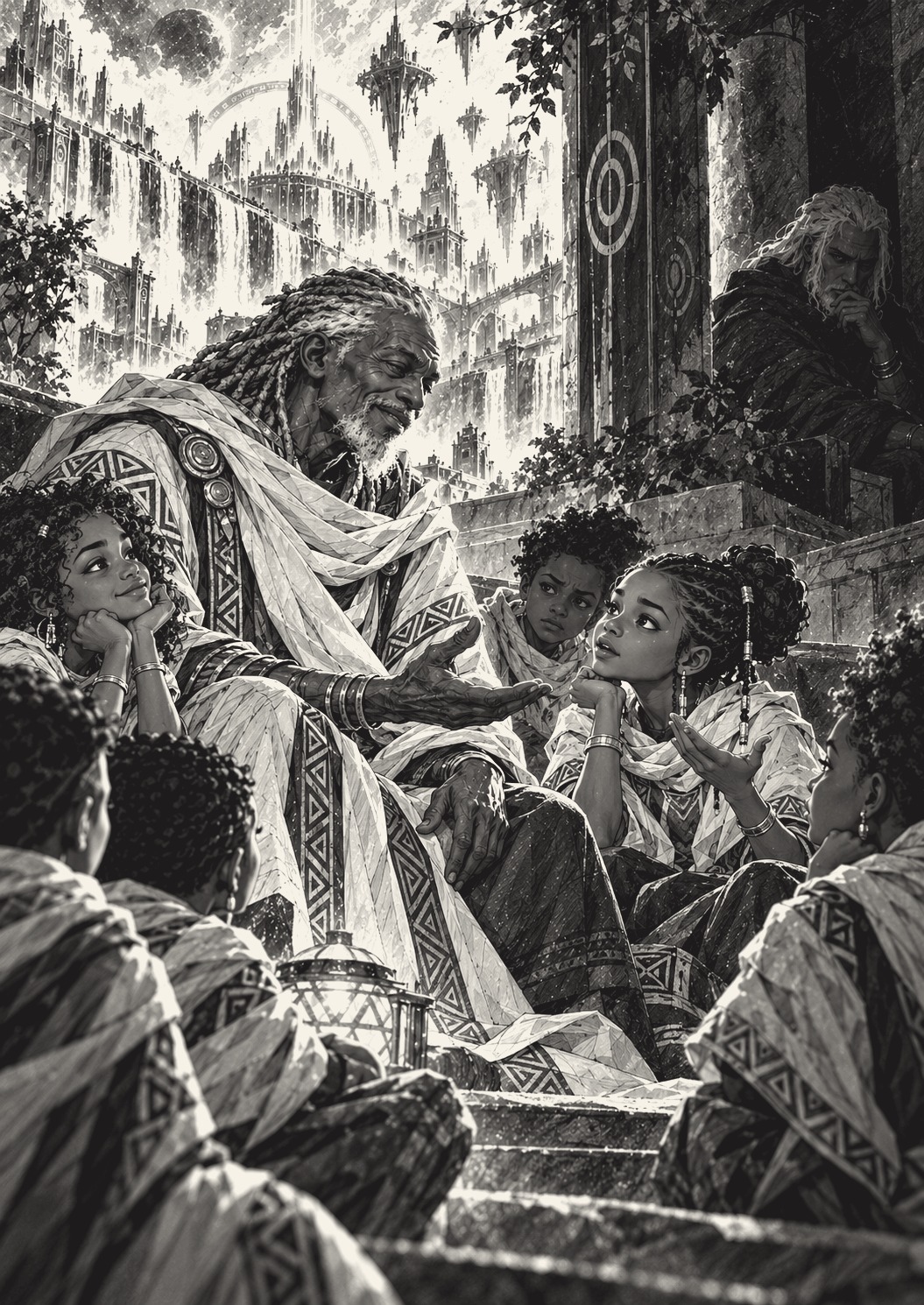
The figure had one eye, one arm, and one foot. Its maker had given the eye an expression of considerable suspicion.
"There," Tuti said from the far end of the bench. "It looks exactly like you when someone asks for evidence."
Nkele looked from the carving to Tuti.
"My son, if I had only one arm, you would have fewer opportunities to be struck with it. Be grateful."
Several people laughed. Tuti leaned back, delighted.
"You see? Violence instead of argument."
"I have been arguing with you since you were small. I am entitled to diversify."
"You're admitting defeat?"
"I'm admitting fatigue. They are very different."
Diya, her long braids partly covered by a pale headwrap, had been examining the event times on a compact display at the edge of the table. Gold thread marked the cuffs of her narrow-sleeved garment; her dark eyes scarcely left the readings as she switched the instrument off. To the people who worked with the Great Protector of Time, those apparently small discrepancies were sometimes the most dangerous. She slid the display into her bag. "He's still going to explain why the monster has one eye?"
"I might," Nkele said. "If someone here can manage to listen without diagnosing the story."
"That excludes Diya," Tuti said.
"It excludes anyone who interrupts me."
"Then it excludes you," Konzo observed. "You interrupted your own story last time to correct the way an uncle was holding a spoon."
"The spoon was being mistreated."
"It was a spoon."
"And you were not there when it was made."
Nzitani laughed into her cup. The laughter came easily tonight, and for a moment she was annoyed with herself for noticing that. She had not come to conduct an inquiry. There were people she loved within reach of both hands, a warm cake in front of her, and an old man preparing to argue with everyone in the courtyard. It was enough.
Someone brought out another bench. Madiedie arrived carrying a folded cloth and a stack of plates she had volunteered to wash. The cloth had slipped from her shoulder and she adjusted it with the patient care of someone who noticed a table's unsteady leg before anybody else spilled a cup. Her hair was gathered neatly away from her face, her eyes alive to whichever guest had been left without a place. Nuni followed—older now, full of effortless movement and loud opinions, with thick curls and an expression that could make even a complaint sound like the beginning of a game—protesting that volunteering on his behalf had been an abuse of friendship. They had grown since the afternoons when they chased each other between these steps; Nuni’s objections had changed considerably less than his height.
"I didn't volunteer," he said.
"You offered to help if there was food," Madiedie replied.
"That was a conditional offer."
"There's food."
"Then where's the condition?"
"On your plate, when you've finished carrying these."
She handed him the cloth. Nuni looked to Nzitani for support and found none.
A young child passed through the group with a piece of fruit in one hand and a bit of string in the other. Nzitani watched him pause to let Madiedie through. She had seen him somewhere, she thought, perhaps near the lower market. He glanced toward the wooden Kinkuma, then hurried after the other children.
By the time the lamps were lit, Nkele had succeeded in seating everyone in precisely the places they had not intended to occupy. An elderly woman surrendered her preferred chair to a little girl who was too embarrassed to accept it. Two cousins shared a cushion and spent five minutes complaining about its size. Tuti moved the storyteller's stool so he could see the figure properly; Nkele moved it back; Tuti moved his own chair instead. A technician from the west district, still wearing one work glove, stood under the arch and ate from a bowl without taking his eyes off the gathering.
When the courtyard finally settled, Nkele raised the wooden Kinkuma.
"This is a creature," he announced, "about whom very little is agreed."
"It has one foot," said a girl in the front row.
"Very good. An observation."
"And one arm."
"Another observation."
"And one eye."
"You are doing splendidly. In another hour, we shall have established that it is made of wood."
Nuni, from the back, said, "You could have started there."
"But then what would we do with the hour?"
He set the figure on the broad arm of his chair, where it leaned forward as if impatient to hear the answer. He talked first about Kinkuma, and immediately found himself required to explain three different stories of its origin. One family insisted it had once belonged to a warrior. Another said the warrior was the creature. A third said the mistake began when a storyteller confused the two in a song.
Tuti wanted to know whether the confusion had improved the song.
Diya wanted the earliest record.
A grandmother, who had eaten half a plate of roasted vegetables without saying a word, declared that the earliest record was her mother's memory and that Diya was welcome to travel back and interview her if she doubted it.
"I'd read the interview," Diya said, entirely serious.
The grandmother laughed so hard her shoulders shook.
"Would you want the oldest copy?" asked the little artificial assistant housed in the table's audio tile. The voice belonged to a neighborhood archival system that could locate family accounts, recipes and repair histories. It usually kept quiet during meals unless someone had called on it.
"Not yet," Nzitani answered.
"Then I will leave the older accounts closed."
"Thank you."
Nkele inclined his head toward the tile. "See?" Nkele said. "Even the table knows when to keep quiet."
"I can still hear you," the assistant replied.
"I know. That was meant as praise."
Madiedie looked at the little tile. "You don't have to answer him."
"Thank you," the assistant said.
Diya turned the tile face down before someone asked it to retrieve the entire municipal archive. No one objected. Nkele resumed turning Kinkuma between his fingers.
Nkele let the disagreement run its course. He had an exquisite sense of when to speak and when to allow people to make the story for him. When it became impossible to hear which ancestor had owned the sword, he raised one hand.
"Very well. Let us go back a little further."
"How far?" asked a child.
Nkele glanced up at the evening sky. A distant route of the Mbenza line shone briefly between the towers like a silver seam opening and closing.
"Far enough that the way we speak of places begins to trouble us."
He pointed at the rooftops across the courtyard.
"You know where you live. In a house, on a street, in a city. Beyond it there are other cities and other lands. We use Nza for a world, a domain in which lives unfold. And when you look above us, what do you see?"
"The sky," several children said.
"Yulu," one corrected.
"Good. Yulu. The visible sky above our heads. But there are stories of Zulu, and it would be foolish to suppose that every other domain can be reached merely by climbing higher."
"Why?" Nuni asked.
"Because higher is a direction you know here."
"It's a useful direction."
"It is. I recommend it to anyone trying to escape a flooded cellar."
"Then if I build a machine that goes high enough—"
"You might discover a very expensive way to become lost."
A boy sitting on the paving stones frowned. "If they're not above the sky, why call them sky places?"
"Because people use words they already have when they encounter things for which they do not yet have better ones."
Diya folded her arms. "That doesn't tell us what Zulu is."
"No," Nkele said cheerfully. "It tells you why the question is harder than you hoped."
Konzo looked at Nzitani. "He has been waiting all evening to say that."
"He's been waiting since breakfast," she whispered.
Nkele heard them anyway.
"You two may whisper after I'm finished. Or loudly, if it will be more interesting."
The children wanted to hear about the travellers: who had gone, how they had returned, what they ate, whether other beings slept, whether there were villages and families beyond the worlds they knew. Nkele entertained most of the questions and refused to be hurried through the rest. There were routes that depended on a passage rather than a distance, he said. There were traditions concerned with Ntumpa, with thresholds and crossings; others concerned themselves with how one journey could remain a journey when the ordinary markers of travel were absent. He did not offer these as a diagram of everything. He told them as stories people had carried home, argued over, and sometimes passed down incorrectly.
At the suggestion that an explorer might have forgotten to bring enough food, Madiedie interrupted.
"Then the expedition was badly organized."
"You see?" Nkele cried. "At last a woman with sense. I have spent years warning people against poorly provisioned adventures."
"You've also spent years eating other people's provisions," Tuti said.
"Experience is the finest teacher."
Nzitani watched the children's faces while they listened. Some stared toward the sky, trying to imagine whatever lay beyond it. A retired teacher near the back repeated an unfamiliar elder's name under her breath, then frowned when asked which generation he belonged to. She said she had heard the name from her father. Another guest thought his grandmother had said the same. Neither stayed with the question long enough to turn it into a dispute. Others were simply waiting for another absurd remark from Nkele. An older boy had begun drawing the Kinkuma in a little book, making the creature look increasingly ferocious each time the storyteller raised his voice. Nzitani took out her own notebook. She had begun keeping it when her father's absence had made little incidents feel suddenly worth saving: the things people said at dinner, a repair someone completed, a joke that would be unbearable to explain later if she forgot its exact words.
She added the date at the top of a clean page. The ink caught slightly on the paper. The clock on the nearest pillar advanced another minute. She didn't compare it with Diya's instrument; the evening was too pleasant to make into another investigation.
Evening at the terrace. Nkele claims Kinkuma came here unwillingly. Tuti claims Nkele resembles Kinkuma. Everybody agrees Tuti should be fed before being allowed to speak.
She stopped writing to look at Tuti, who had accepted a second serving and was telling the children that an expedition whose food was stolen by Nkele could not be considered scientifically sound.
"What?" he said, catching her eye.
"Nothing."
"You've written something."
"I have."
"About me."
"Not everything concerns you."
"You've been spending too much time with Konzo."
Konzo bowed his head in acknowledgment. "I'm an excellent influence."
"On yourself, perhaps," Diya said.
◆
It was during the pause that followed that a boy spoke from near Nkele's chair.
"Where did you hear the stories?"
The question was quiet, but Nkele's face brightened at once.
"From those who came before me."
The boy stood just inside the reach of the lamplight. Nzitani could see the edge of his sleeve and one bare foot beside the stool. He seemed younger than the students who had been asking most of the questions, and his seriousness made the adults near him smile.
"Did anyone really come before you?" he asked.
Nkele turned his head.
"Of course. Why?"
"I thought you were older than the universe."
Something extraordinary happened to Nkele's expression. His eyebrows rose. His lower lip pressed inward. He looked toward the adults, perhaps expecting someone to correct the boy, and found only faces struggling not to laugh.
"Older than the universe?"
The boy nodded.
Nkele put the wooden figure carefully on the table.
"Who told you this?"
"Nobody. I worked it out."
"Oh, you worked it out."
"I can explain."
"I'm sure you can."
The boy began with his father, who had seen Nkele when he was young. Then his grandfather, who had apparently said the same thing. Parents were old, the boy explained, and grandparents were older; therefore someone who had been old when both generations were young must be the oldest person anyone could remember.
Nkele listened with growing dismay. When the boy finished, he searched the nearby table.
"Where is the little mirror?"
A woman handed him one from her basket. Nkele held it at arm's length and inspected his face as gravely as Diya might examine a damaged instrument. He turned toward the lamplight, smoothed his beard, and tilted the mirror until the brightest reflection struck one cheek.
"Look," he said to the boy. "Look at this face. What about it suggests that I am older than the universe?"
"You're old."
"I am handsome."
"You can be both."
Nkele stopped looking into the mirror.
Around the courtyard a laugh escaped, was suppressed, and multiplied.
"You can be both," he repeated. "What generosity."
"I meant you know so many stories," the boy said quickly. "And you tell them so well. I love them."
Nkele considered the compliment. He adjusted the shoulder of his robe.
"Hmm. Now, that is a clever child. You should have started there."
"And my father says you look exactly the same as when he was little."
Nkele's approving expression vanished.
"Your father's getting older and taking it out on me. That's what this is. You see what you expect to see."
He consulted the mirror again. The boy waited courteously.
"By the way," Nkele went on, "if you're so determined to know my age, why not simply ask me?"
"For what?"
"So you can know."
"But I already know you're old!"
At the western column, Kieleka's mouth changed by the smallest degree. Wete saw it and nearly missed the next line of the argument. Kieleka had spent most of the evening watching people pass through the entrance; for once, he looked entirely at Nkele.
Nkele lowered the mirror into his lap.
"Your father taught you something about speaking confidently only of what you've witnessed, didn't he?"
The boy looked pleased to have his father quoted.
"Yes. He says you shouldn't say you're sure unless you saw it. That's the rule of old people."
"An excellent rule. Did your father witness my birth?"
"No."
"Then how does he know how old I am?"
The boy took this seriously. He narrowed his eyes and looked at Nkele, searching for a flaw in the argument.
"He saw you when he was young," he said at last.
"Which proves that I was there. Not that I was old."
"But you looked old."
"Ah. Here we are again."
"And you still do."
Nkele looked toward the ceiling as though there might be some higher authority willing to intervene.
"These children. I spend an evening telling stories, and they repay me by calling me a fossil. Look at me. Do I look like a fossil?"
"But you're the one who said you're an elder."
Tuti slapped the edge of his chair.
"That is a fair objection."
"Nobody asked you," Nkele said.
"I wasn't going to say anything," Tuti said.
"You already did," Diya told him.
Madiedie, laughing, bent to rescue a plate that had begun sliding toward the edge of a stool. Konzo reached across Nzitani for the little mirror, which Nkele surrendered with an injured dignity that lasted exactly as long as it took the boy to smile at him.
"I was a mischievous child myself," Nkele admitted. "Quite mischievous. It pains me to see how little progress civilization has made since then."
"Were you handsome as a child?" the boy asked.
"Immensely."
"More handsome than now?"
"Careful."
"Can you prove it?"
Nkele stared at him, then broke into laughter. The boy laughed with him. Nkele had a deep, generous laugh that seemed to begin somewhere beneath his ribs and find its way out slowly; he laughed so thoroughly that he had to put a hand on the table to steady the Kinkuma before it fell.
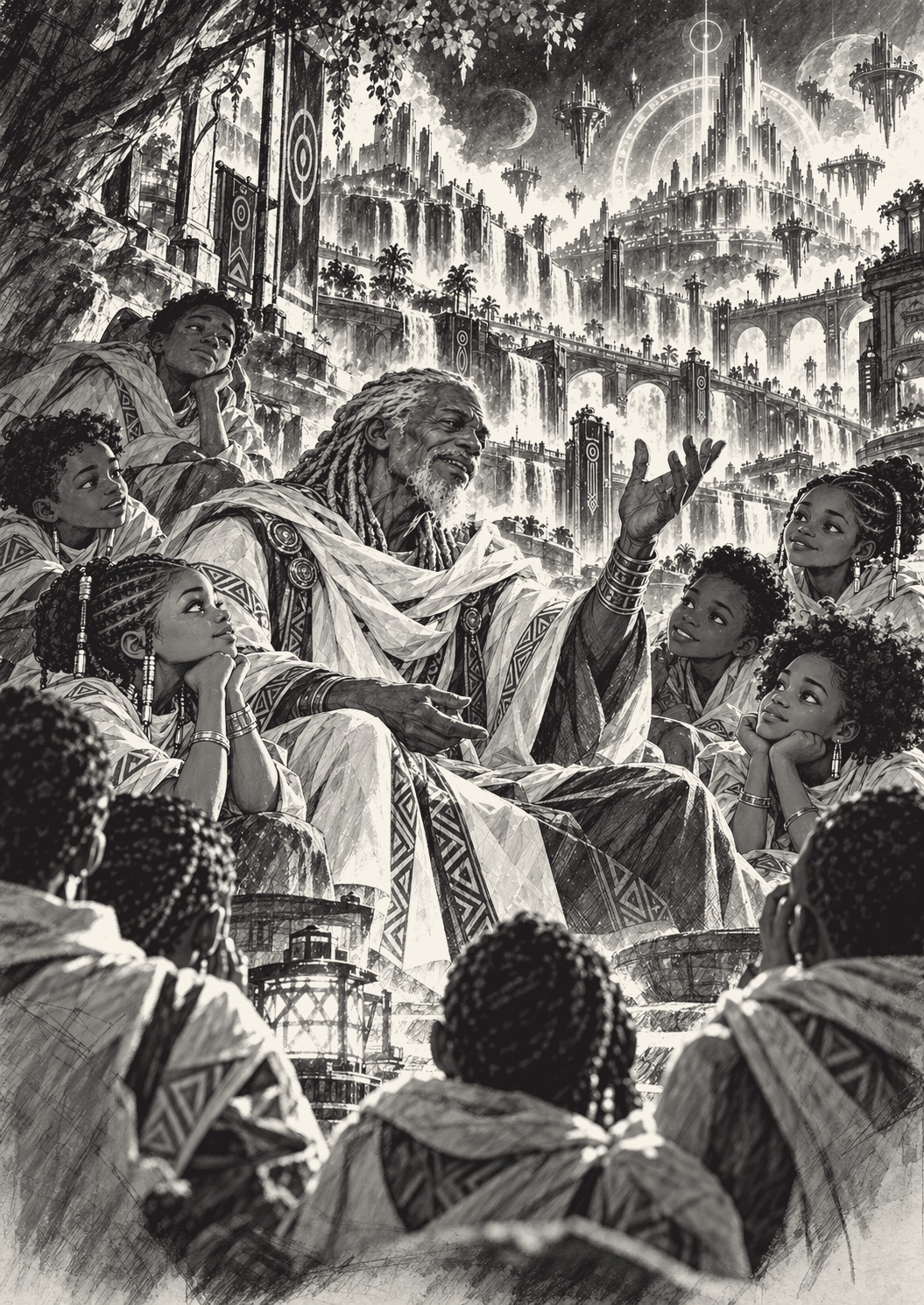
For a moment the whole courtyard gave itself over to the sound. People who had missed the argument laughed because everyone else was laughing. A nurse at the back tried to repeat the child's reasoning to a companion and became helpless at the part involving grandparents. Someone called for a drink. Someone else asked whether Nkele was going to tell another story before all the cakes disappeared.
From the serving area, a woman who had gone inside to fetch more cups looked across the courtyard. Nkele was partly screened by the heavy western column. His face was turned toward its shadow, his right hand still lifted in animated protest.
"Is Nkele all right?" she asked.
"He seems happy enough," said the woman beside her.
"Who is he arguing with now?"
Her companion followed the direction of her gaze. The children were all seated around the front of the stage, except those moving between the benches with plates and cups. From where they stood, the column hid most of Nkele's chair.
"Probably himself," she said. "He's been threatening to do that for years."
"He'll win," the first woman answered.
They returned to the cups.
Nkele took a long drink before attempting to speak again. The boy waited at his knee, still smiling, while Tuti enjoyed himself openly from the far bench.
"You," Nkele told him, "have been waiting all evening for an excuse to behave badly."
"I've been behaving very well," Tuti said.
"You threatened to put my wooden Kinkuma on trial."
"It has no evidence to support its story."
"It's made of wood."
"That doesn't excuse anything."
Nkele's laughter returned in a low rumble. He turned the figure in his hand, examining its one eye and crooked little foot as though it might help him decide what to do about Tuti.
"You know, my siblings used to complain about me when I was young. They said I never knew when to leave a question alone. Or a person. Especially a person."
Tuti sat up. "You? Annoying? I refuse to believe it."
"You may laugh, but it was a serious accusation. Entire evenings were ruined by the things I wanted to know."
"Were you worse than me?"
Nkele looked him over. Slowly enough that Tuti glanced down at himself, then up again.
"No," the elder said at last. "You're much too like my younger self for my taste."
Tuti's grin spread. "So I was right."
"About what?"
"Being interesting."
"I was interesting. You are exhausting. There is a difference."
"A difference of age?" Diya asked.
"Don't you start."
The children laughed. Tuti leaned back, pleased with himself, but Nkele had begun smiling in a quieter way. He stroked the wood where countless fingers had polished it smooth.
"My siblings would tell you I was always finding trouble," he said. "Though they liked to forget who started it. They were very good at forgetting that."
◆
Behind the benches, Nuni was looking for another cup. He had given his to a visiting grandfather who claimed the walk from the lower terraces had worn him out, then spent five minutes arguing with the man about which terraces counted as lower. Nuni was still recovering from the defeat when he noticed a stranger sitting near the breadfruit tree.
The stranger was an elderly man in a plain, dark travelling wrap. His sandals were dusty. White threaded his short beard, and the deep lines beside his mouth suggested that he had spent a good deal of time finding people disappointing. Yet he had been listening closely. When Nkele spoke of his siblings, the man's expression changed—not much, but enough for Nuni to notice.
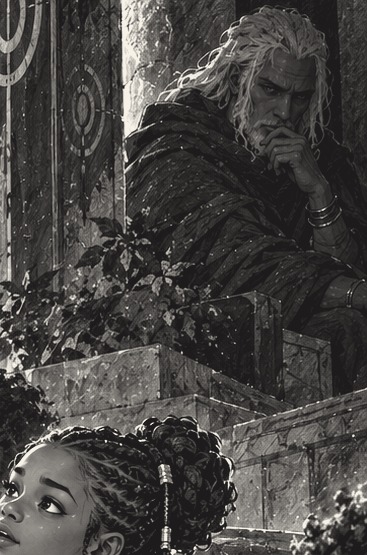
"Excuse me," Nuni said. "Are you one of Mbuta Nkele's brothers?"
The man looked up. "No."
"Or sisters?"
"No to that as well."
"Sorry. He said he had siblings, and you look about the same age."
"Do we?" The stranger glanced toward the storyteller. "He does remind me of a brother of mine, now you mention it. Always talking about how handsome he was. And telling stories. Excellent stories, according to him. My brother, though—"
"So he isn't your brother?"
"No."
"You said he reminded you of him."
"I did."
"And you're the same age."
"You said that."
Nuni took another look at Nkele, who had begun performing an exaggerated imitation of his younger self for Tuti's benefit. His grey-streaked locks hung over a shoulder; the lanterns caught the edge of his beard. He looked comfortably old to Nuni.
"That young man," the stranger said, almost to himself, "is far too young to be one of us."
Nuni frowned. "Young?"
"Compared with some."
Nuni gave that a little thought. Since Lulayisu, he had become less confident about judging people's years by their faces. Someone could look younger than an aunt who remembered them as an elder. Asking usually made matters worse. Perhaps this was another of those cases. Or perhaps the stranger was simply older than he looked.
"You came to hear his stories?" Nuni asked.
"Yes."
"Even though you know someone who tells better ones?"
The man's mouth twitched. "I never said my brother was better."
"Then you should tell one afterward."
"No," the stranger said, with the first real warmth Nuni had heard in his voice. "I came to listen."
Nuni accepted that. He had no particular difficulty with people who knew what they wanted. He retrieved a clean cup, promised to bring the stranger something to eat, and hurried back before Nkele could choose a story without consulting him. The old man remained beneath the tree, his gaze on the gathering.
"Are you going to tell us what happened?" Madiedie asked.
"I might. I was a magnificent child. You would have liked me."
"I'm not sure I like you now," Tuti said.
"That's because you have good instincts."
Wete laughed into his cup. Beside him, Konzo tried to hide a smile and failed. The quiet ease between them had taken years to earn: jokes exchanged during training, meals after exhausting patrols, arguments that had continued even when the three of them no longer agreed about whose fault anything was. Tuti could still make Konzo painfully conscious of his interest in Nzitani with a single raised eyebrow. Wete generally found this more entertaining than helpful. Tonight Nzitani sat close enough to remind all of them that she could answer for herself.
"Tell us one," said the child at Nkele's knee.
"About your childhood," another added.
"No, the first time you met Mbuta K!" called a young student from the back.
"He's already told that one," said an older woman.
"He tells a different version every year," somebody answered.
"That does not mean he remembers it differently," Diya said. "It means he tells it differently."
"Thank you," Nkele said. "Finally, someone understands art."
"I didn't say I approved."
"I take back the compliment."
From the rear bench, Nuni called for the story about the warrior who had lost his sword. A grandmother immediately objected that the sword had not been lost. One of the retired soldiers said the question was who had been holding it. His wife, seated beside him, thought it mattered rather more who had been too tired to hold it any longer.
"Mavungu!" someone called.
"Kinkuma," Tuti said.
"They aren't the same," the grandmother told him.
"I didn't say they were."
"You were about to."
"You can't prove that."
Nkele looked around the circle. The name had made its way from the children's bench to the elders and back again, gathering arguments as it went. He lifted the little wooden figure and regarded it with an expression of great personal disappointment.
"Again?" he said. "Why do you always want stories about this thing?"
"This thing?" The boy beside his chair sounded genuinely offended. "It's Kinkuma."
"I know what I brought."
"He embodies Destiny."
Nkele turned the carving in his hand, bringing its single eye level with his own. There was something ridiculous about the two of them staring at each other so solemnly, especially when Nkele was plainly losing the argument with a piece of wood.
"Destiny," he repeated. "This? But he isn't even—"
"He's great, isn't he?" Tuti said.
"I was about to say something."
"You looked impressed."
"I looked concerned. There's a difference."
Tuti grinned, and Nkele set the figure on his knee with exaggerated care.
"Tell me something. Have I become invisible? You spend the entire evening asking about a creature with one foot. Meanwhile, I am sitting here with two perfectly good feet and a lifetime of vastly more interesting experiences. When I was young, I—"
"We know you," Nuni said.
Nkele put a hand to his chest. "What a cruel thing to say to an elder."
"He means we can ask you things whenever you come," Madiedie said. She had moved an unsteady stool away from the children and was settling onto the bench beside them. "We can't ask Kinkuma anything."
"Have you tried?" Nkele asked.
"He never answers," the boy at his knee said.
"You see? Very poor company."
"But the stories are good," said Nuni. "And nobody tells them like you."
Nkele considered this. "That last part was better."
"Please?" the boy asked.
Another child echoed him, and then two of the adults joined in, smiling. The retired soldier wanted the blade. The grandmother wanted the part before the blade. Someone who had heard neither version said they ought to begin wherever Nkele pleased, provided he began before the last cakes were gone.
"All right, all right." Nkele raised both hands. "I am wounded. You have preferred a wooden monster to the company of a charming man, and I shall remember it. But you have asked so nicely that I will forgive you. This once."
"You said that last time," Diya observed.
"And I forgave you last time. You see how generous I am?"
"The blade," Nuni reminded him.
"Patience. Some of you seem to think stories grow on trees."
"There are trees all around us," Tuti said.
Wete laughed into his cup. Konzo had started to laugh too, though he was careful not to make himself the next object of Tuti's attention. Beside them, Kieleka reached out and steadied the small table before a passing child caught its leg. His expression scarcely changed. He had heard versions of Mavungu's story at Nkamba and farther away. None had improved because somebody told it louder. Nzitani noticed a fresh cut on his knuckle as his hand left the table; she would ask him about it when they were alone.
Nzitani laid her notebook across her lap. "Let him begin. Then everyone can argue about what he actually said."
"I reserve the right to object before he starts," Tuti said.
"You've already done that," Diya replied.
"Then I'm prepared."
Nkele lifted Kinkuma again. Its crooked leg cast a long, improbable shadow over his robe.
"Very well. Kinkuma. And perhaps Mavungu, though three families here will probably insist they told me the story themselves. Get ready. And if you're going to interrupt, at least make it interesting."
"We make no promises," Tuti said.
"Naturally. Now listen."
◆
The argument continued for another moment or two, but with the happy, half-whispered urgency of people arranging themselves for something they wanted. A boy carried his grandmother's stool closer to the light. Someone quietly moved the groundnuts out of Tuti's reach. The neighborhood assistant, silent throughout the dispute, dimmed the lamps above the serving tables while leaving Nkele's chair in a pool of warm amber. Beyond the open gallery, the upper falls breathed into the night. Farther out, the observation platforms held steady above the dark green routes. For these few hours the city was simply a place where people could gather and listen.
Nzitani uncapped her pen. In the margin she drew Kinkuma as Nkele held him: a single eye, an awkward arm, one foot that looked too small to carry the body. She added a second line for the sword, then stopped. She wasn't sure which account the sword belonged to, and that uncertainty made the sketch feel unfinished in a way she liked.
She had meant to ask the little boy his name. He was no longer where he had been standing. She looked past the baskets and the people settling their chairs. Perhaps he had followed the others nearer the front. Perhaps he was already outside, playing at being an explorer with the string she had noticed earlier.
A plate lay on the ground beside his former place, with half a cake on it. Nobody seemed to know whose it was. Nzitani bent to retrieve it; the cake was still warm.
She made a small note beneath the drawing: Ask the boy his name. She could do it when Nkele finished.
When she looked up, the old traveller beneath the breadfruit tree was watching Nkele rather than the children. He turned his head before their eyes met. Nzitani thought no more of it. It was a good evening, and she did not want to spend it studying strangers.
"Are we agreed?" Nkele asked.
"Not at all," said the grandmother.
"Good. Then we're ready."
He raised the wooden Kinkuma to where every face could see it. For the first time that evening even Tuti was quiet.
Nzitani closed her notebook over the unfinished drawing. Somewhere in the courtyard, a child laughed. She glanced toward the empty place and tried to decide whether it was the same voice. By the time she turned back, Nkele had lowered his hand.
"Now," he said. "Tell me which part of this story you are sure is true."
Someone began to answer. The old man smiled, not at the answer but at the certainty.
Then, with Kinkuma looking out over the gathered faces through its single wooden eye, Nkele began.